ADA Playground Requirements: Rules, Surfacing & Zones Explained
Table of Contents
- A wheelchair-friendly ramp alone won't satisfy ADA playground rules. Surfacing can quietly fall out of compliance within months, and one overlooked pillar could leave kids unable to reach equipment at all. What's the full four-part framework parks teams actually need?
- Key Takeaways
- Four Pillars Every Checklist Needs
- Mapping the Accessible Route
- Counting Ground-Level and Elevated Components
- Choosing Surfacing That Stays Accessible
- Setting Safe, Compliant Use Zones
- Can I Get There, Stay, and Play?
- Compliance Is an Ongoing Commitment
- FAQs
A wheelchair-friendly ramp alone won't satisfy ADA playground rules. Surfacing can quietly fall out of compliance within months, and one overlooked pillar could leave kids unable to reach equipment at all. What's the full four-part framework parks teams actually need?
Key Takeaways
- An ADA compliant playground needs a connected accessible route, the right mix of ground-level and elevated play components, compliant surfacing, and safe use zones working together, not as separate checkboxes
- Accessible routes need a running slope no steeper than 1:16, a cross slope no steeper than 1:48, and a clear width that is usually at least 60 inches
- At least one of each type of ground-level play component must sit on an accessible route, and at least half of elevated play components must be reachable the same way
- Surfacing has to meet the ASTM F1951 standard for accessibility, but meeting that standard once is only the starting point since loose-fill materials shift and compact over time
- Little People's Cove suggests that planning around three simple questions (can a visitor get there, stay, and play) helps project teams catch gaps that a plain checklist might miss - find more expert insights below
Planning an accessible public ADA playground involves far more than ordering a ramp and calling the job finished. Municipal parks teams juggle federal guidelines, surfacing science, and long-term maintenance all at once, and missing one piece can leave an otherwise beautiful playground off-limits to some visitors.
A clear framework helps keep every requirement in view from the earliest site plan through the ribbon-cutting and beyond.
Four Pillars Every Checklist Needs
An ADA playground checklist holds together when it treats four elements as connected parts of one system rather than isolated tasks. Those four pillars are the accessible route, the mix and reach of play components, compliant surfacing, and properly sized use zones around equipment. Skipping or under-planning any single pillar tends to create a weak link that undermines the other three, since a child who reaches a beautifully surfaced play structure by way of a route that is too narrow or too steep never actually gets to use it.
Specialists in commercial-grade play environments approach accessibility as a design puzzle that starts at the parking lot and ends at the last piece of equipment, rather than as an afterthought bolted onto a finished layout. Thinking about the four pillars together from day one, rather than retrofitting them later, tends to save both budget and headaches.
The sections that follow break down each pillar in detail, starting with the route that brings people into the play area in the first place.
Mapping the Accessible Route
An accessible route is the backbone connecting everything else on a playground site. Without a continuous, unobstructed path, even the most inclusive play structure becomes inaccessible to the people it was designed to serve.
From Parking Lot to Play Equipment
The accessible route should begin well before a visitor ever reaches the play structure. It needs to connect the building or parking area to the play area itself, then continue from the edge of the play area all the way to the equipment. Outside the play boundary, this can mean parking access aisles, curb ramps, crosswalks across vehicular ways, access to restrooms, and connecting walkways or ramps. Inside the boundary, the path may include platforms or ramps that lead directly to individual play components. Planning this full chain early prevents the common mistake of designing an accessible play structure that sits at the end of an inaccessible walkway.
Width, Slope, and Surface Rules Along the Way
Specific measurements govern how usable a route actually is.
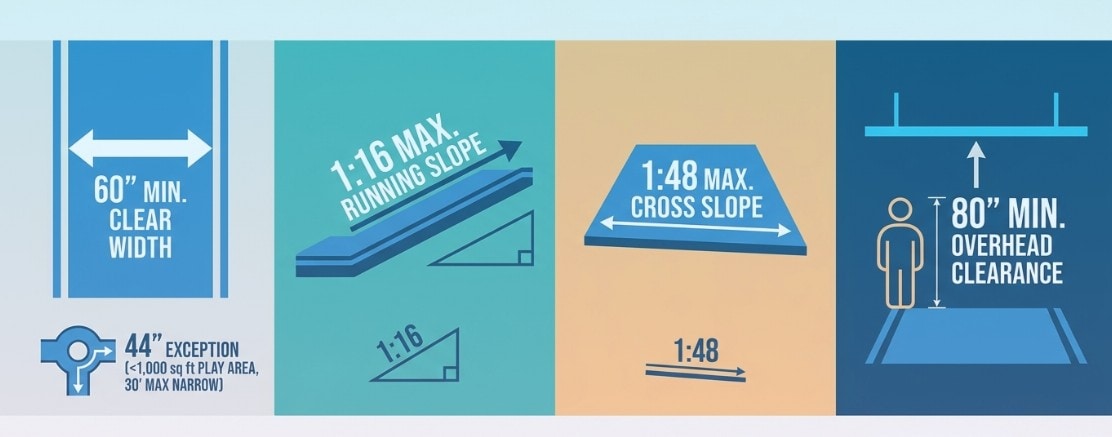
- A ground-level accessible route generally needs a minimum clear width of 60 inches, though a narrower 36-inch segment is allowed for stretches no longer than 60 inches when wider segments bookend it.
- Vertical clearance along routes serving ground-level components should be at least 80 inches, preventing overhanging branches or structures from becoming hazards.
- Slope matters just as much as width: running slope should never exceed 1:16, and cross slope should stay within 1:48.
- Surfaces along the route also need to be firm, stable, and slip-resistant, with any gaps or openings small enough that a half-inch sphere cannot pass through them.
These numbers may look technical on paper, but they translate directly into whether a wheelchair, walker, or stroller can move smoothly from one point to another without getting stuck or tipping.
Counting Ground-Level and Elevated Components
Once the route is mapped, attention turns to what visitors find once they arrive. Play areas typically include a combination of ground-level components, which are reached and exited right at grade, and elevated components that are part of a composite structure and approached above or below grade.
Ground-Level Rule: One of Each Type
The baseline rule is straightforward: at least one of each type of ground-level play component present in the play area should sit on an accessible route. If a playground includes a ground-level spring rider, a sensory panel, and a digging station, each category needs at least one accessible example, even if additional units of that same type are placed elsewhere without the same route requirement.
Pinecone Playground Play Panels
$4,731.00
Pinecone Commercial Playground Play Panels - Engaging Infant and Toddler Play Structure for Ages 6-23 Months Introduce infants and toddlers to the joy of learning… read more
Shop Now!
Elevated Components: Counts Scale With Structure Size
As composite structures grow larger and add more elevated components, the number of required accessible ground-level components grows with them. For play areas offering two to four elevated components, at least one ground-level component of a different type needs to be on an accessible route. Once a structure reaches five to seven elevated components, that minimum rises to two ground-level components representing two different types. Beyond specific counts, the overarching rule holds for the whole play area: at least half of all elevated play components must be reachable by an accessible route, giving children who cannot climb full access to a meaningful share of elevated play experiences rather than a token one or two.
Ramps Required at Larger Composite Structures
As structures scale up further, ramps become a specific requirement rather than just one of several options. Play areas with 20 or more elevated components need ramps serving at least a quarter of them, ensuring that larger, more elaborate structures do not rely solely on transfer systems or climbers to meet their accessible-route obligations. This scaling approach reflects a practical reality: a small structure with a handful of elevated features can achieve meaningful accessibility with a single ramp or transfer point, while a sprawling composite tower needs multiple accessible paths distributed across its elevated components.
Choosing Surfacing That Stays Accessible
Surfacing ties the accessible route and the play components together physically, and it carries its own detailed standard.
ASTM F1951 and Material Options
Surfacing along accessible routes and beneath play equipment must meet ASTM F1951, the standard covering accessibility of surface systems under and around playground equipment. Where a route or clear ground space falls within a component's fall zone, that surfacing also needs to meet the applicable impact-attenuation standard, since the same material has to protect against falls and support mobility devices at the same time. Several material categories can meet these dual demands:
Poured-in-place rubber provides a uniform top layer, which makes it especially smooth for wheelchairs, walkers, and strollers moving across it.
- Rubber mulch provides a loose-fill alternative with a more natural, textured look.
- Rubber tiles offer a modular installation approach that can simplify repairs to isolated sections.
- Synthetic turf delivers a grass-like appearance while still meeting surfacing standards.
- Engineered wood fiber remains a widely used loose-fill option, particularly where budget or local preference favors a more natural material.
Each option carries different maintenance demands, and that difference matters enormously for long-term accessibility.
Setting Safe, Compliant Use Zones
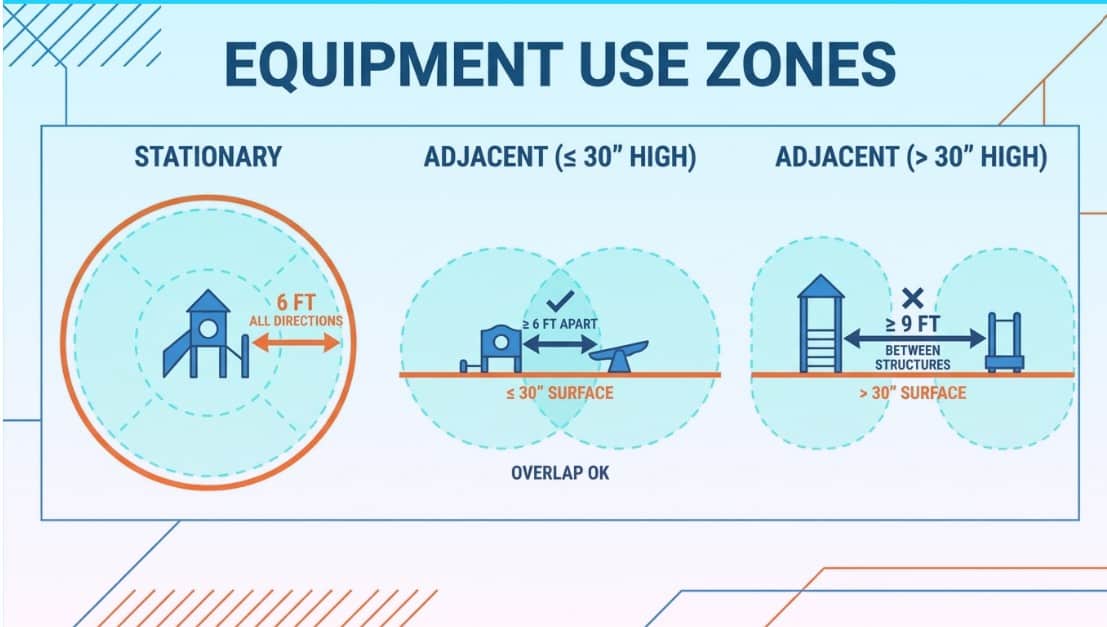
A use zone is the ground-level area beneath and surrounding a piece of play equipment where a user is expected to land if they fall or exit the structure.
- The recommended use zone extends a minimum of 6 feet beyond the perimeter of a platform or equipment edge, and that space needs to stay clear, unobstructed, and covered by appropriate safety surfacing at all times.
- Thinking of a use zone as a dedicated buffer rather than simply leftover space helps project teams avoid the common error of placing benches, signage, or landscaping too close to active equipment.
- Because use zones overlap with the surfacing requirements already covered, any gap in surfacing depth or consistency within a use zone creates a safety concern in addition to an accessibility one, making routine surfacing checks a two-for-one maintenance task worth prioritizing.
Can I Get There, Stay, and Play?
Checklists are useful, but three simple questions can reveal gaps that a line-by-line review sometimes misses:
- Can a visitor get there?
- Can they stay?
- Can they play?
"Can I get there?" tests the accessible route from parking through the play area entrance and up to individual components. "Can I stay?" considers whether a visitor, caregiver, or sibling can comfortably remain in the space, which touches on shaded seating, firm surfacing for stationary wheelchairs, and clear sightlines. "Can I play?" asks whether the available components actually offer meaningful participation once someone arrives, rather than just technical proximity.
Running a design or an existing playground through all three questions pushes planning past minimum compliance and toward a space that genuinely works for the people who use it every day. Applying the framework during the design review stage, rather than after construction, gives project teams a chance to make adjustments while changes are still inexpensive.
Compliance Is an Ongoing Commitment
Meeting ADA playground requirements at the ribbon-cutting ceremony marks the beginning of an obligation, not the end of one. Surfacing settles, mulch compacts, equipment wears, and signage fades, all of which can quietly erode accessibility over months and years even when the original design met every standard. Building a recurring inspection routine into a parks department's maintenance calendar, with particular attention to surfacing depth and consistency around high-impact areas like swings and slide exits, keeps a compliant playground compliant rather than letting it drift.
Treating the four pillars, the accessible route, component counts, surfacing, and use zones, as a connected system that needs periodic review protects both the community's investment and its youngest residents' right to play.
For teams mapping out a new project or auditing an existing site, Little People's Cove has more resources highlighting accessible outdoor play equipment to help align component choices with these requirements from the start.
FAQs
What are the ADA requirements for playgrounds?
ADA playgrounds must provide an accessible route, accessible ground-level play components, compliant surfacing, and access to elevated equipment where required.
What playground surfacing is ADA compliant?
Compliant surfacing must be firm, stable, and slip-resistant, and must meet ASTM F1951 for accessibility and ASTM F1292 for impact attenuation.
Is mulch or engineered wood fiber ADA compliant?
Yes, if properly installed and maintained to stay firm, stable, and slip-resistant. Loose-fill materials require regular raking, replenishment, and inspection.
How wide does an ADA playground accessible route need to be?
The standard minimum is 60 inches wide, with limited exceptions for smaller play areas or short route segments.
How many accessible play components does a playground ne
The required number depends on the total number and type of play components, with specific rules for ground-level and elevated equipment.