
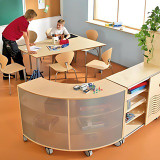
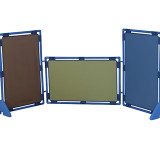
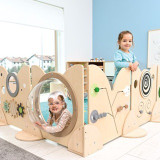
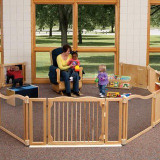
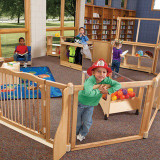
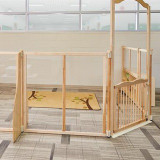
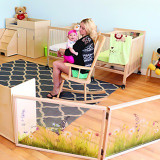

Organize learning spaces with classroom room dividers designed for preschools, daycares, and elementary schools. Create defined activity areas, reading corners, and small-group workspaces with durable partitions that support flexible classroom layouts and everyday supervision.
Filter By
Products List
There are no products listed under this category.
Classroom Room Dividers for Flexible Learning Environments
Create organized, adaptable learning spaces with classroom partitions that help educators define activity areas without permanent construction. From preschool play zones to elementary learning centers, room dividers make it easier to arrange shared spaces for different activities while maintaining a functional classroom layout.
Modular Partitions & Learning Center Dividers
Classroom dividers are available in different heights, materials, and configurations to accommodate a variety of educational settings.
Modular panels allow schools to create custom layouts, while transparent partitions maintain visibility between activity areas. Solid panels establish stronger visual boundaries, and selected designs incorporate mirrors, magnetic surfaces, or write-and-wipe features.
Bookshelf dividers combine room separation with accessible storage, helping educators organize learning materials while defining classroom zones.
Some systems include compatible connectors, gates, and entryway components for more structured arrangements.
Benefits of Classroom Room Partitions
Thoughtfully arranged dividers provide practical advantages for busy educational environments.
-
Defined Spaces: Separates classroom activity zones.
-
Flexible Layouts: Accommodates changing learning needs.
-
Organization: Establishes clear classroom boundaries.
-
Visual Control: Helps manage nearby distractions.
-
Space Efficiency: Makes shared rooms more functional.
-
Activity Transitions: Supports structured classroom routines.
Ideal for Preschools, Daycares & Elementary Schools
Commercial classroom dividers work well in childcare centers, preschools, Head Start programs, elementary schools, libraries, and shared educational spaces.
Educators can use partitions to separate art stations from reading corners, establish small-group instruction areas, and define spaces for independent activities.
In early childhood classrooms, appropriately sized partitions help organize play centers while preserving sightlines for supervision. Larger educational facilities can use taller panels to create more distinct work areas.
Choosing the Right Classroom Divider System
Start by measuring your classroom and identifying which activities need separation.
Consider divider height, panel width, visibility, available floor space, and whether the layout will change frequently.
Compare freestanding and connected systems, paying attention to stability, compatible hardware, and manufacturer installation requirements. Mobile options may offer additional flexibility, while modular systems can support coordinated arrangements.
For high-traffic classrooms, review materials, edge construction, cleaning requirements, and age suitability. Maintain clear walkways, accessible exits, and appropriate supervision throughout the space.
Frequently Asked Questions
What are classroom dividers used for?
They define activity zones, separate learning centers, and organize shared educational spaces.
Are room dividers suitable for preschool classrooms?
Yes. Age-appropriate dividers can establish learning areas while allowing teachers to supervise children.
Can classroom partitions be rearranged?
Many modular and freestanding designs allow layout changes, although some systems require connectors or mounting hardware.
What is the difference between a bookshelf divider and a panel divider?
Bookshelf dividers provide storage and room separation, while panel dividers primarily establish visual or physical boundaries.