5 Activity Tables for Elementary Classrooms: Options Compared
Table of Contents
- You probably have a LEGO table and a sensory bin in your classroom. But here's what most educators miss: each activity table builds completely different skills, and without the right combination, you're leaving major developmental gaps unfilled.
- Key Takeaways
- Not All Activity Tables Develop the Same Skills
- LEGO Tables: Construction Meets Curriculum
- Magnetic Sand Tables: Low-Mess, High Engagement
- Themed Tables: Rotate With Your Curriculum
- Light Tables: A Dedicated Discovery Center
- General Sensory Tables: The Classroom Workhorse
- One Table Isn't Enough - Use All Five as a System
- FAQs
You probably have a LEGO table and a sensory bin in your classroom. But here's what most educators miss: each activity table builds completely different skills, and without the right combination, you're leaving major developmental gaps unfilled.
Key Takeaways
- Not all activity tables develop the same skills - each type targets a distinct area of early learning, from fine-motor control to STEM reasoning.
- LEGO, magnetic sand, themed, light, and general sensory tables each serve a unique classroom purpose, and using them together creates a well-rounded learning environment.
- Little People's Cove offers a curated selection of activity tables across these five categories, making it a practical starting point for classroom planning.
- Mess level and age range vary significantly between table types - understanding both helps educators make smarter purchasing decisions.
- The strongest early learning setups treat these five tables as a coordinated system, not isolated furniture purchases - more on that below.
Walk into a well-equipped Pre-K or kindergarten classroom and you'll likely spot several activity tables arranged in distinct zones. Each one is doing a different job. The challenge for educators isn't finding activity tables - it's knowing which types to prioritize and why. This comparison breaks down five commercial options by the skills they build, the age ranges they serve, and how they fit into a real classroom.
Not All Activity Tables Develop the Same Skills
Activity tables aren't interchangeable. A LEGO table builds spatial reasoning and narrative thinking. A magnetic sand table targets fine-motor control and calm, cooperative engagement. A light table opens up visual-sensory investigation. Each one creates a different kind of invitation to learn, and that distinction matters when planning centers for young children.
Early childhood learning environments are most effective when structured around richly provisioned, purpose-driven centers that support holistic development. That principle applies directly to how activity tables are selected and arranged. Little People's Cove organizes their activity table offerings around exactly this logic - grouping tables by function rather than just by size or price - which makes it easier for educators to build a coherent center layout.
The five types covered here - LEGO, magnetic sand, themed, light, and general sensory - represent the highest-engagement options in commercial early learning furniture. Together, they cover construction, sensory investigation, imaginative play, visual discovery, and open-ended exploration.
LEGO Tables: Construction Meets Curriculum
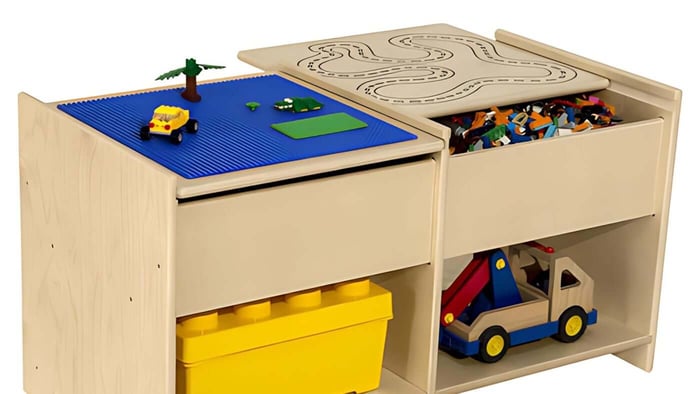
LEGO tables are a staple in preschool and primary classrooms because they naturally bridge hands-on play with clear academic connections. Children building at a LEGO table aren't just stacking bricks - they're practicing counting, grouping, early engineering logic, and narrative thinking when builds connect to a class book or theme.
STEM, Math, and Storytelling in One Surface
The academic range of a LEGO table is wider than it looks. Towers and bridges introduce basic structural concepts. Pattern building connects directly to early math. Story-based builds - where children recreate scenes from a read-aloud or invent their own - layer in language and sequencing skills. That combination of construction, math, and storytelling in one surface is difficult to replicate with any other table type.
Ages 3-8: Built-In Storage Makes Medium Mess Manageable
Most commercial LEGO tables designed for classrooms include LEGO or DUPLO-compatible baseplates and integrated storage bins or central wells, typically seating two to four children. The built-in organization matters in a classroom setting - loose bricks are accounted for, and cleanup becomes part of the routine rather than a disruption. Mess level runs medium, and the age range of 3-8 gives these tables a long useful life across Pre-K through early elementary grades.
Magnetic Sand Tables: Low-Mess, High Engagement
Magnetic sand tables occupy a unique space in the classroom center lineup. They combine sensory engagement with science exploration - without the mess that typically comes with either.
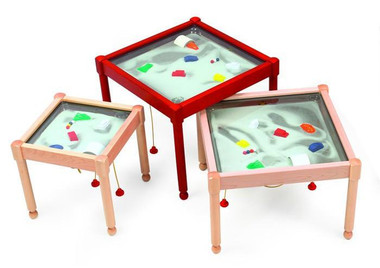
Standard Square Magnetic Sand Table
$1,203.36
Magnetic Sand Activity Table - Sensory Exploration Play Station Invite calm, creative play with the Standard Square Magnetic Sand Table. This engaging sensory activity table...… read more
Shop Now!Fine-Motor and Cooperative Play Without the Cleanup
A standard magnetic sand table features a wooden frame with a clear acrylic top, fine sand and magnetic shapes enclosed inside, and magnetic wands or handles operated from underneath. Children move pieces through the sand to create paths and pictures, take turns guiding shapes, or test magnetic force by experimenting with what the wands can and can't move. As Little People's Cove notes in their product descriptions, these tables are specifically designed to promote fine-motor control, hand-eye coordination, and calming sensory input - making them particularly valuable for sensory-seeking students or those who benefit from a quieter, more contained center. Suitable for ages 3-10, they stay relevant well into early elementary. Mess level is genuinely low, which is part of why they also appear in school libraries and waiting areas.
Themed Tables: Rotate With Your Curriculum
A themed table is less about a fixed product category and more about how a standard activity table is provisioned. The surface itself is flexible - what changes is the material set placed on it.
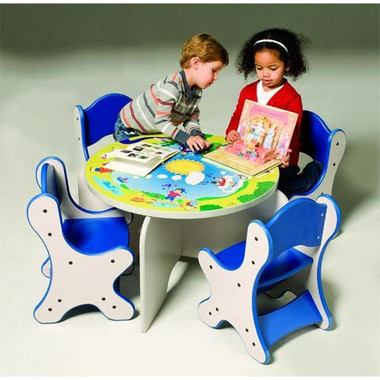
Harmony Park Kids Table & Chairs Set
$1,323.42
Playscapes Harmony Park Table & Chairs Set - Quiet, Kid-Friendly Seating for Waiting Rooms Create a calm, welcoming space where children can relax and engage...… read more
Shop Now!Vocabulary, Pretend Play, and Concept Reinforcement
Common setups include transportation kits with road mats, ocean animal collections, farm scenes, seasonal nature trays, or community helper dramatizations. The table rotates to match whatever the class is studying that week or month, which keeps the center feeling fresh and directly reinforces curriculum vocabulary. Children engage in pretend play, storytelling, and fine-motor exploration - all framed around the concepts already being introduced in circle time or read-alouds. Many preschool programs find it beneficial to rotate themes at activity tables regularly, often positioning them near areas where curriculum connections are strongest, such as the circle-time area. Mess level runs low to medium depending on the materials used, and the age range typically spans 3-7.
Light Tables: A Dedicated Discovery Center
Light tables bring a distinctly different sensory experience to the classroom. The backlit acrylic surface transforms ordinary materials - translucent blocks, colored letters, leaves, fabric swatches, even X-rays - into objects worth studying carefully.
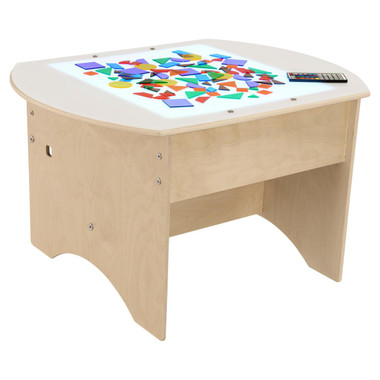
Contender Brilliant Light Table
$689.78
Contender 30" Brilliant Light Table - Sensory Activity Table for Kids Spark creativity and sensory discovery with the 30" Brilliant Light Table. This colorful sensory...… read more
Shop Now!Visual-Sensory Exploration and STEM Investigation
Children use light tables for color mixing, shape patterning, letter and number tracing, and science investigations with thin natural objects. The illuminated surface makes details visible that would otherwise go unnoticed, naturally slowing children down into a more focused, observational mode. Activities like arranging translucent manipulatives, working with mirrors, or examining images develop both fine-motor precision and visual-processing skills. Mess level stays low, and the age range of 3-8 makes these tables a solid investment across multiple grade levels.
A Natural Fit for Reggio-Inspired Classrooms
Light tables are especially common in Reggio Emilia-inspired programs, where they function as dedicated investigation centers. In that framework, the table is often paired with what educators call a provocation - a curated invitation that sparks children's natural curiosity and self-directed inquiry. Whether or not a classroom follows the Reggio philosophy formally, the light table's design encourages open-ended, child-led discovery.
General Sensory Tables: The Classroom Workhorse
If every early learning classroom has one activity table, it's usually a sensory table. These are the most flexible option in the group - and also the most demanding in terms of setup and cleanup.
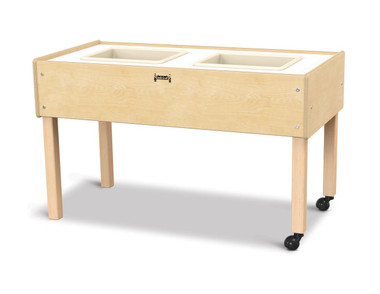
2 Tub Children's Sensory Table
$514.59
The 2 Tub Sensory Table by Jonti-Craft is a versatile and engaging addition to any sensory play area. This sturdy table features two large tubs...… read more
Shop Now!Open-Ended Play With Rotating Fillers
General sensory tables consist of tubs or basins mounted in a table frame, sometimes fitted with lids for containment and storage. The filler rotates: sand, water, rice, dried beans, kinetic foam, pebbles, seasonal nature materials. Children scoop, pour, sort, bury, and discover - building fine-motor skills, practicing early science concepts like floating and sinking, and engaging in calm, regulated play. Sensory play has well-documented benefits for neuropathway development and emotional regulation, and these tables are particularly supportive for neurodivergent learners. Age range runs 2-7, and they're typically positioned near easy-clean flooring for good reason - mess level is medium to high depending on the filler. Despite that, they remain a classroom standard because the developmental return is consistently high.
One Table Isn't Enough - Use All Five as a System
Each table type covered here serves a distinct purpose, and that's precisely the point. When educators treat these five tables as a coordinated system rather than isolated purchases, classroom centers become far more intentional. Here's a quick reference for how the five types compare:
A well-balanced classroom layout pairs low-mess tables - light and magnetic sand - near carpeted or quieter zones, while positioning sensory tables close to tile or easily cleaned surfaces. Themed tables work well near the circle-time area where curriculum connections are strongest. LEGO tables anchor construction centers and benefit from proximity to block or building areas. Thinking about placement, supervision sightlines, and noise levels alongside table type leads to a center layout that actually functions day to day - not just in theory.
Educators building or refreshing their activity center setup can view the full range of options at Little People's Cove, where activity tables are organized by type to support exactly this kind of purposeful classroom planning.
FAQs
What table height is right for preschool vs kindergarten vs early elementary?
For most classrooms, the right table height depends on age/grade and chair size. The key idea is: children should sit with feet flat on the floor, knees and hips at about 90°, and the tabletop roughly 7–8 inches above their thighs.
Quick height ranges by age/grade
These ranges come from school furniture guides and ergonomic recommendations.
Preschool (ages ~3–5)
Typical chair (seat) height: about 9–12 inches.
Typical table height: about 17–22 inches, with many guides clustering preschool around 18–20 inches.
Kindergarten (roughly ages 5–6)
Typical chair height: about 12–14 inches.
Typical table height: about 20–24 inches, with many charts recommending 22–24 inches for K–1.
Early elementary (grades 1–3, roughly ages 6–9)
Typical chair height: about 12–16 inches.
Typical table height: about 22–26 inches (often 24–26 inches for 2nd–3rd grade).
Can an activity table be used for more than one purpose (e.g., LEGO plus a covered top for blocks/trains)?
Yes. Many activity tables are designed to be multi‑purpose, so one table can serve as a LEGO building center and, with a cover or reversible top, become a flat surface for blocks, trains, puzzles, or art. This lets teachers change the activity by simply flipping the top or adding the cover, saving space and budget while keeping the table in constant use throughout the day.
What materials (laminate, wood, plastic) are easiest to sanitize and keep looking good?
Laminate and quality plastic tops are usually the easiest to sanitize and keep looking good, because they’re non‑porous, resist stains, and can handle frequent disinfecting without much wear. Sealed wood tables can also be a good option as long as they have a strong protective finish, which keeps moisture and cleaning products from soaking into the surface and makes daily wipe‑downs straightforward.