Wooden Train Tables in Museums: Why Contained Play Areas Boost Focus
Table of Contents
- Ever wonder why kids freeze at a train table instead of scattering across a museum floor? The secret isn't the trains - it's a design principle administrators are quietly borrowing for waiting rooms everywhere.Key Takeaways
- The Focus Effect of Contained Play
- How Boundaries Can Help Kids Play Better
- Skills Built at the Train Table
- The Space and Design Trade-Offs
- Applying Contained Play Beyond Museums
- Contained Play Areas Turn Waiting Into Learning
- FAQs
Ever wonder why kids freeze at a train table instead of scattering across a museum floor? The secret isn't the trains - it's a design principle administrators are quietly borrowing for waiting rooms everywhere.
Key Takeaways
Ever wonder why kids freeze at a train table instead of scattering across a museum floor? The secret isn't the trains - it's a design principle administrators are quietly borrowing for waiting rooms everywhere.
- Contained play areas like wooden train tables give children a defined area to work within, which museum professionals link to better focus and less overwhelm.
- Train tables support fine motor skills, spatial awareness, planning, and social interaction, making them a staple exhibit at many children's museums.
- The same contained-play principle behind train tables shows up in wall-mounted and screen-free waiting room activities, including options from Little People's Cove designed for high-traffic healthcare and museum settings.
- Boundaries in play often sharpen problem-solving by narrowing choices to a workable range rather than limiting creativity.
- Administrators weighing floor space against engagement value will find trade-offs worth understanding before investing in a train table or similar exhibit.
Walk past a train table in a children's museum on a busy Saturday and it is easy to spot the difference between that corner and everywhere else in the building. Kids who were bouncing from exhibit to exhibit moments earlier suddenly slow down, lean in, and stay put. That shift is not an accident. It reflects something museum designers and child development professionals have observed for years: contained play spaces change how children engage.
The Focus Effect of Contained Play
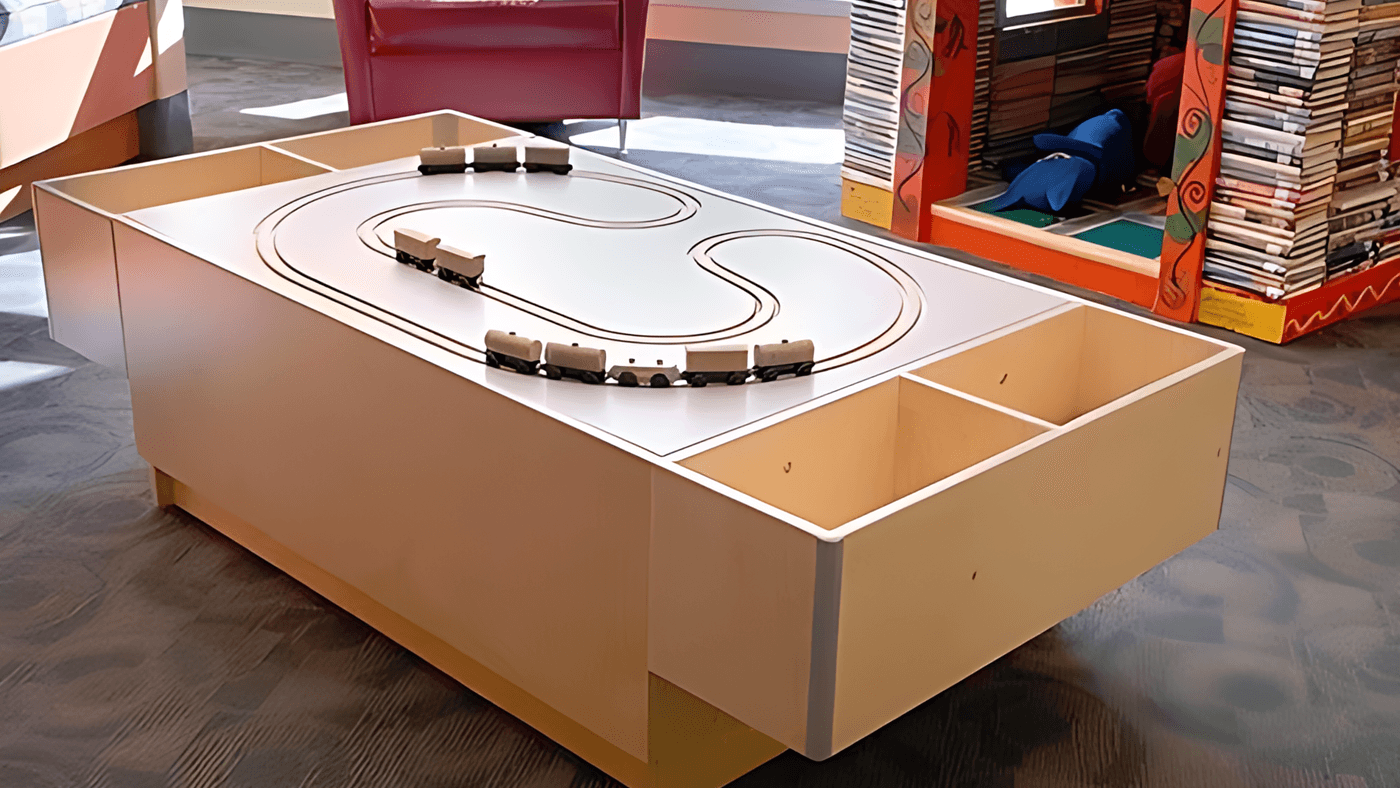
A train table works because it draws a clear boundary around the activity. Instead of an open floor with unlimited directions to run, a child gets a defined tabletop, a set of tracks, and a handful of trains. That boundary does something interesting to attention span. A child's brain narrows in on the puzzle directly in front of them: connecting track pieces, routing a train around a bridge, or fitting one more curve into a loop before it runs out of table.
Museum exhibit teams have leaned into this for good reason. Many children's museums design their train tables with tracks carved directly into the tabletop or with a curated set of loose pieces, giving kids just enough choice to stay creative without becoming lost in options. This children's museum highlights its own train table as a space where children build planning skills, dexterity, and spatial awareness all at once, which is exactly the kind of multi-skill payoff that makes a single exhibit worth the square footage. Wooden train tables demonstrate how a bounded play area can hold a child's attention far longer than an open floor.
That focus effect is not limited to trains. It shows up any time a play environment provides a bounded, purposeful setup rather than a free-for-all. Indoor play spaces that use structure well tend to help children interact more deeply with individual activities, supporting cognitive development and creativity through games and puzzles that reward sustained attention rather than quick sampling.
Express Toddler Train Table with Red Ball Express Train
$353.27
Express Toddler Train Table - Red Ball Express Activity Center Bring exciting train adventures to playtime with the Express Toddler Train Table with Red Ball… read more
Shop Now!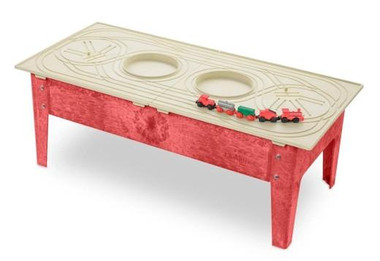
How Boundaries Can Help Kids Play Better
It sounds backward at first. Give a child less room and less stuff, and somehow they play better with what remains. But watch it happen at any train table, and the pattern becomes obvious.
Problem-Solving Over Overwhelm
A three-year-old handed an entire room and unlimited track pieces often freezes or scatters attention across too many possibilities. Hand that same child a defined table and a manageable set of trains, and the questions become concrete: How does this track connect? Does the tunnel fit here? What happens if the loop goes this way instead? Those smaller, solvable problems keep kids engaged far longer than open-ended free play tends to, because there is a clear goal and a visible way to reach it.
Public Spaces vs. Home Layouts
Interestingly, the same table that captures a child's attention at a museum sometimes falls flat at home. Parents report buying a train table after watching their child play happily at a bookstore or toy store, only to find the table at home gets far less use, with the trains ending up on the living room floor instead. Public train tables tend to have tracks glued or carved in for durability, offering a slightly different, more predictable experience than an open-ended home setup. For museum and healthcare administrators, this distinction is useful: the entertainment and focus value of a train table is strongest in that shared, public-facing context, which is exactly where these tables tend to live.
Skills Built at the Train Table
Beyond keeping children occupied, a train table is quietly doing developmental work. The skills built there translate well beyond the exhibit floor.
Fine Motor and Spatial Awareness
Connecting small track pieces, lifting a train over a bridge, and fitting curved sections into a layout all require precise hand movements and hand-eye coordination. Spatial awareness comes into play as children figure out how pieces fit together to form a continuous loop, a skill that carries over into later tasks like assembling puzzles or reading maps.
Planning and Social Interaction
Before a single track piece goes down, a child is often already planning: where should the bridge go, how long should the loop be, will there be room for a tunnel. That mental sequencing is an early form of planning and problem-solving. When more than one child shares the table, negotiation enters the picture too, whether that means dividing up track pieces, taking turns sending a train through the tunnel, or building a shared layout together. These social exchanges, layered on top of the individual focus the table already encourages, make train tables a two-for-one developmental tool in a museum setting.
The Space and Design Trade-Offs
None of this makes a train table the automatic right choice for every facility. Administrators weighing this exhibit against other options should go in with eyes open about what it costs in space and what it saves in risk.
Floor Space and Track Limits
A standard train table commands a real footprint, often three to four feet long and two to three feet wide, and that number does not include the walking space needed on all sides for children to reach every part of the layout. The table's shape also caps creativity in a specific way: the size and shape of the tabletop will always limit how big or elaborate a track configuration can get, even on the largest tables available. For a museum weighing exhibit density against engagement time, this is a real trade-off worth mapping out on a floor plan before committing.
Reduced Fall and Trip Risks for Young Children
On the safety side, train tables offer a clear advantage over floor-based layouts. Keeping tracks contained and elevated means fewer tripping hazards for toddlers moving through a busy exhibit space, and it prevents tracks from being knocked over as frequently as they would be if scattered across open floor. For very young visitors still building coordination, that reduced fall risk is a meaningful safety consideration, and one reason many public train tables keep tracks fixed in place rather than loose.
Children's Activity Table with Bins
$1,459.79
Classroom Activity Table with Bins - Preschool Play Table Create an organized space for hands-on play with the Classroom Activity Table with Bins! This preschool… read more
Shop Now!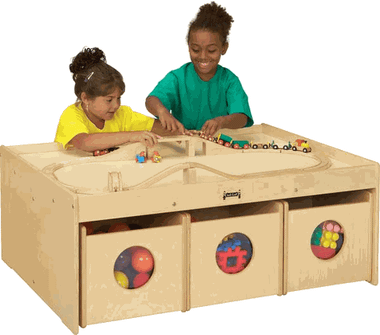
Applying Contained Play Beyond Museums
The logic behind a train table, structure that sharpens focus and lowers overwhelm, extends naturally into other spaces where children wait, including pediatric offices, dental clinics, and therapy centers. Administrators managing these waiting areas face a similar challenge: keep children engaged and calm without dedicating a room's worth of floor space to a single exhibit.
Screen-Free Play Options for Waiting Areas
Screen-free activities that are simple, durable, and easy to use tend to work best in these settings, since they hold up under constant handling and do not require supervision to operate correctly. Magnetic maze games, for example, are a strong fit for pediatric clinics because they keep older children engaged in a calm, constructive way while building focus, problem-solving, and hand-eye coordination. Commercial-grade sensory panels, bead mazes, and magnetic games designed for these high-traffic settings give healthcare and museum administrators contained play options that mirror the train table's focus-boosting structure without the same footprint.
Wall-Mounted and Space-Saving Play Choices
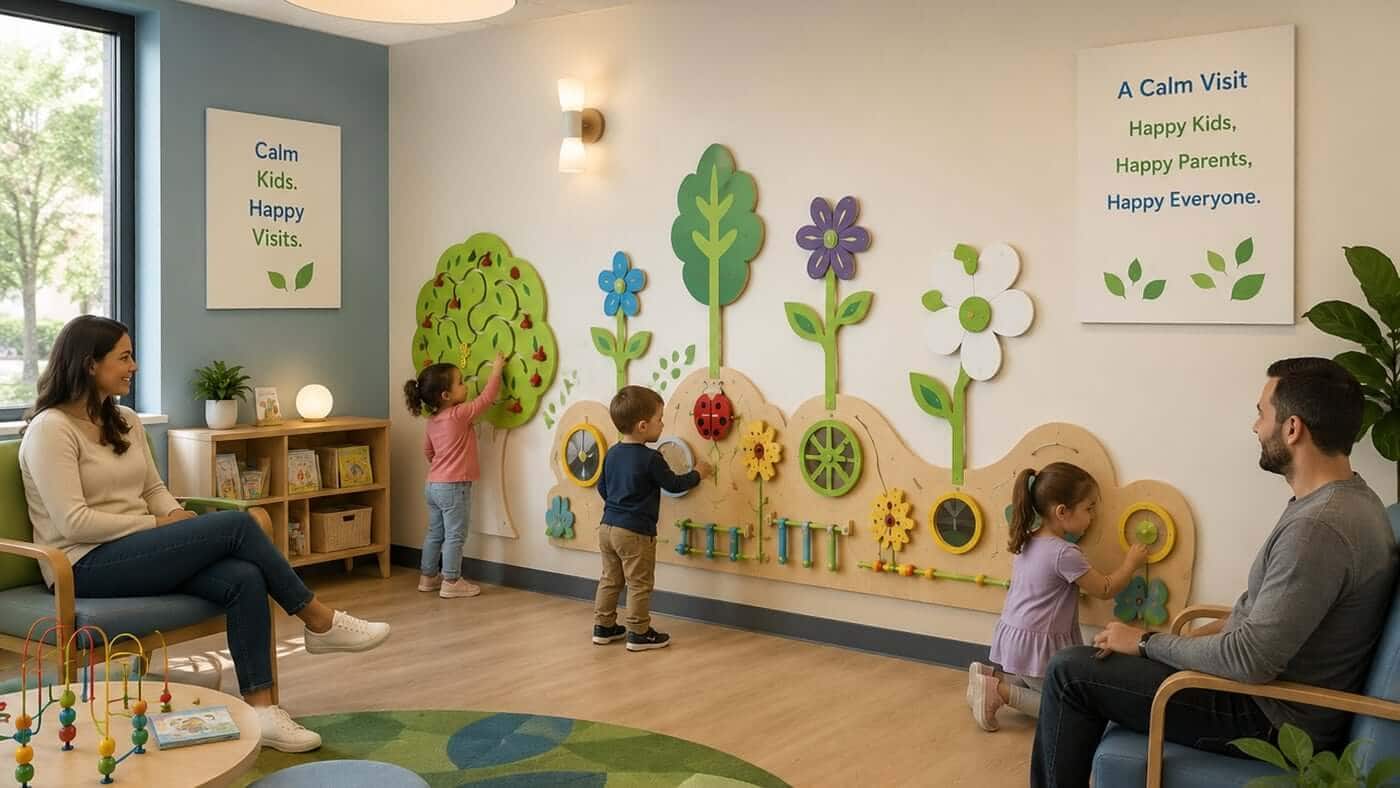
For facilities where floor space is at a premium, wall-mounted games and activities solve several problems at once. They preserve floor space entirely, reduce trip hazards since nothing sits at ankle height, limit the risk of missing pieces since components stay attached to the panel, and keep children busy without generating loose parts that need constant cleanup. This makes wall-mounted sensory panels a natural extension of the contained-play principle for facilities that cannot spare a corner for a full train table setup.
Contained Play Areas Turn Waiting Into Learning
The evidence from museum exhibit design and waiting room best practices points in the same direction: children focus better, problem-solve more effectively, and often feel calmer when their play environment offers structure rather than an open, undefined space. A train table proves this on a grand scale in a children's museum, drawing kids in for extended stretches of hands-on learning. The same principle scales down neatly into a pediatric waiting room or hospital lobby, where a wall-mounted sensory panel or magnetic maze can turn a stressful wait into a few minutes of quiet, focused play.
For administrators planning a new exhibit or refreshing a waiting area, the takeaway is straightforward: structure is not a limitation on play, it is often the ingredient that makes play work. For facilities ready to adopt this approach, screen-free waiting room activities built around the same contained-play principles offer a practical next step.
FAQs
What age is a train table best for?
Most train tables are labeled for ages 3 and up, and many are recommended for ages 3 to 8. Some toddlers start enjoying them around 18 months, and a low table can also give babies who are learning to stand something to lean on. Always check the age label and supervise very young children.
Do you actually need a train table?
No. Track sets work fine on the floor or on a regular table. A train table keeps pieces contained, saves your floors from track clutter, and gives kids a defined play spot. That is especially useful in waiting rooms, classrooms, and therapy spaces where you want play to stay in one area.
Do train tables come with trains and track?
Usually not. Many tables are sold alone, and the train set is a separate purchase. Some bundles include track, a train, and accessories, so check the product description before you buy.
Will my existing wooden train set work on the table?
Often yes. Many tables work with popular wooden railway brands such as BRIO and Thomas & Friends, but compatibility varies. Check the listing before you buy, especially if you already own a set.
Can a train table be used for more than trains?
Yes. Many are multi-purpose and work for LEGO or building blocks, puzzles, and art. Reversible tops, such as a plain surface on one side and a printed scene on the other, make them more versatile.